
Share this
by Ben Dunlap on January 27, 2026
How to Leverage AI to Build Attendee and Exhibitor Confidence at Your Events
Trade shows have always been about one thing: human connection. Having thoughtful industry conversations, making new discoveries, and forging new relationships on the show floor is the mission of every person present at your trade show. However, the challenge everyone faces is feeling overwhelmed or missing out on key connections or opportunities because there are too many things to see and do and only so much time.
AI should be used at trade shows to give attendees and exhibitors confidence. Confidence they are in the right place, talking to the right people, and spending their time in ways that move them closer to their goals. When AI is embedded directly into the attendee and exhibitor experience—rather than layered on as a separate tool—it helps remove uncertainty, friction, and guesswork. People show up more prepared, more focused, and more willing to engage.
For more perspective on how AI is shaping trade shows and why this shift matters now, see 3 Ways AI Will Change the Trade Show Industry in 2026.
The Right Way to Use AI: Creating Space for Better Human Interaction
The real goal of AI at events is to create space, time, and mental bandwidth for people to connect more meaningfully. When attendees aren’t overwhelmed by options or unsure where to go next, they feel confident making decisions. Personalized recommendations, proximity-aware guidance, and tailored agendas help attendees spend less time navigating and more time engaging.
When exhibitors aren’t guessing whether their investment is paying off, they engage more strategically. Real engagement signals—beyond simple badge scans—give exhibitors clarity on attendee intent, meeting quality, and follow-up priorities.
Thoughtful AI helps:
- An attendee who feels overwhelmed feel oriented and purposeful
- An attendee confidently discover relevant exhibitors, sessions, and people aligned to their goals
- An exhibitor who feels uncertain feel prepared and in control
- An exhibitor prioritize high-value conversations and book more meaningful meetings
- An organizer replace guesswork with clarity and insight
That confidence changes behavior on the show floor.
The Wrong Way to Use AI: Automation That Distances People
As AI becomes more common at trade shows, the risk isn’t that events become too advanced—it’s that they become impersonal or ignored altogether. When AI feels generic, intrusive, or disconnected from real attendee and exhibitor goals, people disengage.
AI should never short-circuit human interaction or automate it away. Used poorly, it adds noise. Used well, it removes obstacles. The difference is whether AI understands your event ecosystem—your floor plan, your exhibitors, your sessions, and your audience behavior—or whether it’s operating without context.
Read Jason's whole article How AI Strengthens Human Connection.
The challenge for organizers is how to use AI the right way. How do you deploy AI thoughtfully, so it enhances everyone’s experience instead of getting in the way or being completely ignored?
Since AI is still a new and evolving tool, it’s easy to use improperly—especially when applying technology to complex and inherently human-driven events. This is why adoption, trust, and usefulness matter more than novelty.
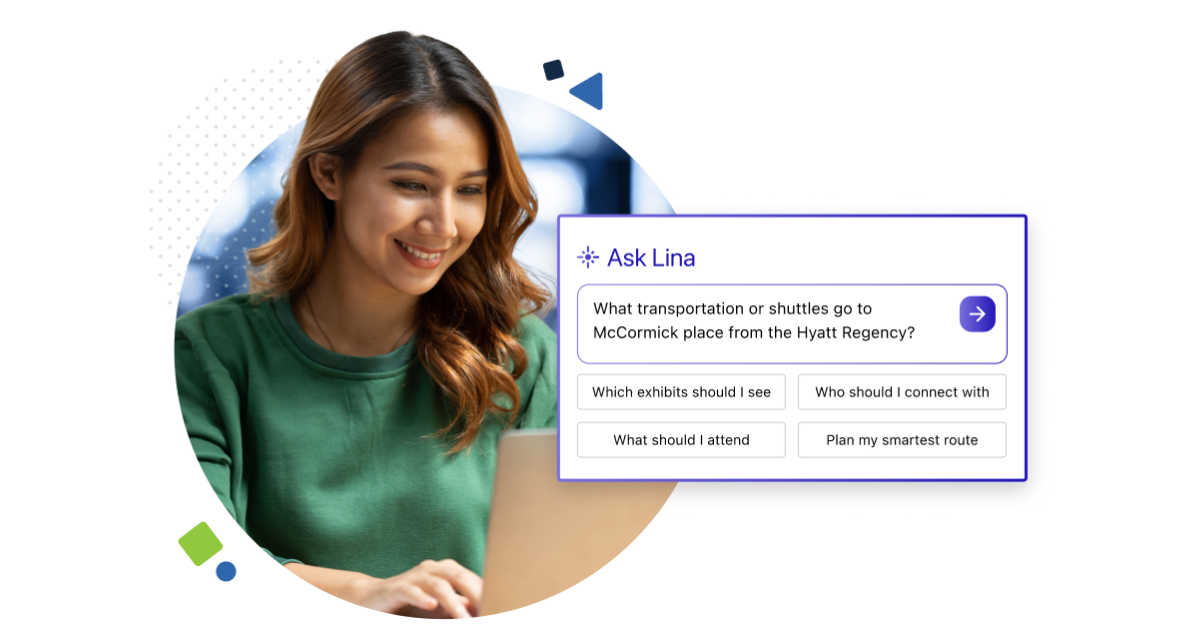
So instead of providing prompt templates for ChatGPT, this guide is centered around strategies to maximize the usefulness and adoption of an AI Assistant being deployed at a trade show and make your AI-incorporated event shine.
DON’T: Let AI Write Speaker Bios, Session Descriptions, or Exhibitor Profiles
Generative AI can make content creation faster, but speed without strategy creates problems. Many organizers and exhibitors use AI-generated bios or descriptions as a shortcut, without considering search behavior, attendee queries, or how AI assistants surface results.
Generic, AI-written profiles often lack:
- Industry-specific language
- Clear value propositions
- The keywords attendees use when searching
When this happens, even the most advanced AI assistants can’t confidently surface or recommend the right booths, products, or sessions—because the signals simply aren’t there.
DO THIS INSTEAD: Teach Exhibitors and Speakers How AI Finds and Displays Them
Explain to exhibitors and speakers that the content they submit isn’t just for humans. It’s being crawled by your AI assistant and the large language models that power search, recommendations, and matchmaking.
Provide guidance that helps them succeed:
- Share examples of strong vs. weak descriptions
- Highlight key phrases attendees actually search for
- Explain that AI won’t recommend booths or sessions if those signals are missing
- Show them how to refine content so it aligns with attendee intent and discovery behavior
When exhibitors understand that better content leads to better visibility, AI becomes a trusted driver of booth traffic and meaningful engagement—not a black box.
DON’T: Let Attendees Arrive Without Knowing About Your AI Assistant
Don’t make the mistake of unveiling your AI Assistant at the same moment attendees pick up their badges. By then, attention is split and habits are already forming.
DO THIS INSTEAD: Introduce Your AI Assistant Before the Show and Encourage Better Input
Through email, notifications, or show-preparedness guides, communicate early how your AI Assistant will help attendees plan, navigate, and connect. Encourage them to complete their profiles ahead of time so recommendations, matches, and agendas can be truly personalized.
Tell them to include:
- Specific goals
- Topics of interest
- Who they want to meet
- What success looks like for them
The more intentional the input, the more precise the paths, recommendations, and connections AI can deliver—especially once attendees are onsite.
DON’T: Rely on a Basic Chatbot With Scripted Answers
Not all AI is created equal. A simple chatbot that answers basic FAQs but breaks down with real questions quickly frustrates users and erodes trust.
Attendees don’t ask simple questions at large events. They ask contextual ones:
- “Which vendors specialize in this solution and are near my next session?”
- “Who should I meet based on my role and goals?”
A scripted bot can’t handle that complexity.
DO THIS INSTEAD: Use a True AI Trained on Your Event
True AI assistance at large events is trained on your specific show landscape. It understands:
- Your exhibitor categories
- Your floor plan
- Your session content
- Your audience behavior
This allows AI to deliver recommendations that factor in relevance, proximity, intent, and timing. To help attendees optimize their onsite experience and exhibitors connect with the right prospects.
DON’T: Upload Static Reports and Ask AI to “Figure It Out”
Uploading basic performance reports into a generic AI tool after the show leads to disconnected insights and missed opportunities.
DO THIS INSTEAD: Use AI for Real-Time Event Insights
When AI is integrated into your event ecosystem, it captures insights before, during, and after the show. That includes:
- Common attendee questions
- Foot traffic patterns and paths
- Exhibitor engagement trends
- Signals explaining why something performed well
These real-time insights allow organizers to adjust, optimize, and confidently prove value—rather than relying on anecdotes or post-show surveys alone.
AI Works Best When It’s Treated as a Strategy, Not a Shortcut
As the saying goes, you get out what you put in, and AI is no exception. When AI is used the right way, trade shows become more human and less robotic.
Many people see AI as a productivity tool. At Map Your Show, we believe its true power is in building confidence, improving decision-making, and connecting the right people at the right time.
We’ve invested heavily in building intuitive AI solutions designed specifically for the event industry. All with the goals of reducing friction, unifying engagement, and delivering clarity across attendees, exhibitors, and organizers.
We’d love to show you the latest AI solutions coming to the Map Your Show platform.
Schedule a demo today to get an exclusive preview of MYS Connected.
